


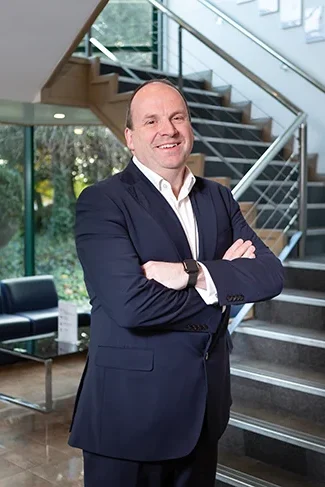
Paragon is a business transformation and consultancy firm, specialising in innovative business services that deliver growth and business efficiency for its clients. It has more than 3,600 employees spread across more than 20 locations throughout the UK, Ireland and Luxembourg. Jeremy Walters, CEO at Paragon, discusses pilot purgatory, Paragon’s leadership model and ESG.
How can CEOs effectively balance localisation for resilience with the efficiencies of global scale amid ongoing geopolitical volatility?
You can’t play a defensive game in this environment; leaders need to be on the offence at all times. My approach is to treat instability as a catalyst for growth. Flip the negative on its head. For me, the strategy is to decentralise for agility but unify for scale. This allows teams to achieve ‘regional market mastery’, giving any organisation the hyper-local expertise that makes them resilient against geopolitical shocks. It’s about market leadership, not just survival; empowering teams in each market is the best way to achieve it.
I always try to back this strategy up with balanced decisions, like Paragon respecting its roots in traditional markets while transforming to meet our clients’ shifting needs. Our capabilities and offerings have grown and the customer communications industry has changed with us – particularly when it comes to cost and compliance. Our move up the value chain strategically de-risks the core and frees capital for growth into high-potential markets.
What steps can leaders take to prevent ‘pilot purgatory’ and ensure technology is scaled enterprise-wide?
I am proud to say that as a business, Paragon is fiercely pragmatic. In my view, ‘pilot purgatory’ is where good money goes to die. To end it, my job as a leader, along with my executive team, is to enforce a strict, financial-first framework: every promising small-scale concept must demonstrate a clear path to becoming a profit-generating product or solution. We don’t chase superficial innovation. Instead, the focus is on tackling complex, fundamental change for the customer, which requires deeper investment and longer contracts to scale real impact. If we commit, then we stay close to the project and embrace the ‘fail fast’ mindset.
In what ways does the modern hybrid work environment intensify the battle for human capacity and how can leadership models evolve to meet these new expectations?
The biggest competitive edge today is human operating capacity. The hybrid world requires us to treat human capital as critical infrastructure, not a cost. The battle for talent is won through empathy. I believe that maximising employee wellbeing and fighting burnout offers the highest ROI investment a company can make. My rule is simple: constantly prioritise the ‘doers’ – the customer-facing staff and operators who are making the money and fighting on the front line every day. The most important part of a successful growth story is the groundwork laid in building trust with your team.
How does Paragon’s shift from defensive localisation to regional market mastery redefine what resilience means in a multinational context?
Resilience can’t just mean surviving. For us, it’s about strategically evolving from a resilient, high-performing business to one that achieves its goal of doubling in size every three years. We redefine it through offensive action. Our regional market mastery strategy creates deep, hyper-local expertise. This is an agile framework that allows us to pursue market opportunities in the face of geopolitical shocks. It proves that true resilience requires the courage to make hard strategic decisions to ensure long-term stability and invest for the future.
What are the risks and rewards of applying a financial-first framework to innovation governance, particularly in fast-changing digital markets?
The reward is quantifiable commercial value. A financial-first framework ensures that my teams are scaling AI and other technologies from hype to high value, instead of getting stuck in ‘pilot purgatory’ mentioned earlier – but there is a risk of stifling the entrepreneurial spirit of some employees. We manage that by balancing our mandate to achieve demonstrable financial returns with the need for strong, ethical governance and the needs of our clients, who can operate in highly regulated markets. The governance itself is the core business case. We ensure that while we encourage free thinkers, we operate within the structure of a mature, global organisation.
By reframing wellbeing as a high-ROI infrastructure investment, how might Paragon’s leadership model challenge traditional cost-control mindsets?
This challenges cost control fundamentally. My belief is rooted in my own past experiences while working for my mother’s catering business. I learnt a lot during this time; mainly that there is a strong link between human capital and financial return. Therefore, maximising employee operating capacity is not a cost centre; it is a strategic investment with the highest ROI. I don’t do this because it’s soft – I do it because it’s the most critical infrastructure for a resilient, profitable business. The results speak for themselves. Our revenue more than doubled. Our EBITDA almost tripled.
To what extent should ESG be integrated into core business strategy rather than treated as a compliance or reputation function?
ESG should be 100% integrated and leaders need to see it as part of a strategy. We view verifiable trust as the most valuable currency and the ultimate licence to grow. Treating it just as compliance makes it a cost; treating it as a strategy makes it a trust engine for growth. This means mandating auditable integrity and verifiable transparency across everything we do. Personal authenticity builds stakeholder trust and models the behaviour needed for the company to champion transparency across all metrics.
What mechanisms can companies use to ensure that decentralisation and empowerment do not lead to fragmented culture or inconsistent governance?
Fragmentation is only truly managed with alignment. Leaders need to ensure their decentralised models can still be unified for scale. For Paragon, this means connecting our specialised business lines to our vision and mission to deliver growth, engagement, transformation and efficiency for our clients. That shared client vision prevents fragmentation. We rely on our culture, which we see as the competitive edge – celebrating that our people have shown impressive leadership as they embrace the new vision, delivering ahead of schedule. Ultimately, culture and strategy must be executed with intelligent and diligent work across the entire global structure.
Looking across the three instability zones – geopolitical, technological and human – what qualities define a truly resilient, human-centric leader today?
A resilient, human-centric leader needs to be three things: an authentic trust-builder, a strategic de-risker and a champion for governed innovation. You need the personal transparency to build trust – that groundwork is essential when you’re driving growth. You need the pragmatic courage to make hard strategic decisions to de-risk the business for the long-term. And you need to be the champion of governed change, balancing an entrepreneurial spirit with the strict, financial-first framework needed to scale technology for profitable impact. Put simply, empathy and trust are not soft principles; they are the most critical infrastructure investments for a resilient modern business.

